Early Cost Estimates for Unfunded Software Projects
Published: Sep 3rd, 2020 by Bill Medved
Introduction
One of the challenges facing software teams when considering
new solutions: “How much will this new project cost?”
There have been a number of costing methodologies that have
evolved over the years. I remember my
first interaction with an agile coach. I
asked him, “How can you determine how long an agile project will take?" The response, “It is done, when it is
done.” Actually, this answer would be OK
in a situation where other departments in the organization were devoted to agile
methodology. Having said that, this
response usually doesn’t play well with investors, and CEO – CFO principals.
When in the early project evaluation stage – we won’t have
all the requirements or time to create a detailed estimate. Many projects are competing for executive
attention, and funding. It cost money and time to
do a deep dive to build out of a full proposal for a new product.
This is key: An early
costing exercise can help gauge the stakeholder’s appetite for investment. This exercise also
considers risks - such that we can get a feel for the stakeholder's tolerance for risk.
A stakeholder may have a high tolerance for risk on one project, while having
a lower tolerance for risk on a different project.
Bigger Picture
Over time I have built a mental model of the challenges
involved in getting funding approved for software projects:
-
Understanding the true value proposition to
customers (what are we building, …)
-
How are we going to monetize the opportunity?
(how are we going to make money, …)
-
Market dynamics (competitors, target market is
niche, vertical or horizontal, …)
-
Risk tolerance for investor on this project
-
Technical effort and risks
And then there are the Organization risks and opportunities:
-
History (legacy product support, …)
-
Adaptability
-
Accelerants and Champions
-
Team capabilities
All of the above are important, and each warrants a
discussion of their own. It is also
interesting to consider how the above factors significantly impact each
other. For example, if our investor has
a very low tolerance for risk for the project, then we must have a higher level
of understanding of what we are building, how we are going to make money on the
solution, and our organizational readiness.
One Piece of the Puzzle
I believe it is important that we, as
technologists, have the ability and tools to provide a response to the business when we
are asked, “Is this the size of a breadbox, SUV or semi?”
In this discussion we will cover a methodology that I
have evolved (along with numerous-much appreciated-colleagues) over the years. This exercise by no means
provides a completed plan with all the details required for a project proposal. It does provide a costing estimate
with
high profile risks identified. It is somewhere between a "back of the napkin estimate" and a full project proposal.
I've used this approach in pre-seed startups, startups and large enterprises.
I usually refer to this exercise as a modified tee-shirt
sizing exercise. It draws on experience from multiple
engineering practices, including agile.
Like any methodology, we can start with a list of “what” we
think we need to do. Even if we don’t
know all the answers, we can create a “thought exercise” list of the things we will
likely have to build. I believe the process of building a list, with an engaged
team, leads to a set of follow on thoughts, ideas and questions that are
invaluable for downstream activities.
The Model
There are many factors that can impact the total effort for a
particular task. Here are the ones that
I’ve found the most impactful for an early estimation exercise:
- Level of Effort as a range
- Risk (Have we done this before?)
- Complexity (Number of moving parts)
- Group Risk (New 3rd parties? Hiring ramps, Contractors, …)
Note these factors can be cumulative. For example, when something is complex, and you haven’t done it
before, it increases overall risk. You should have a reasonable understanding of the project risk profile
when you have completed the early estimation process.
It should be noted:
- Originally, the calculations-tables in this spreadsheet were based on thought exercises. They have evolved
over several years based on high level analysis of project results as compared to original spreadsheet estimates.
- The actual project task list can change by as much as one third (outlier) during project implementation.
Often the removed tasks were replaced by comparable new tasks. At times, I found this turned out to
be restating the originally estimated work in a different manner.
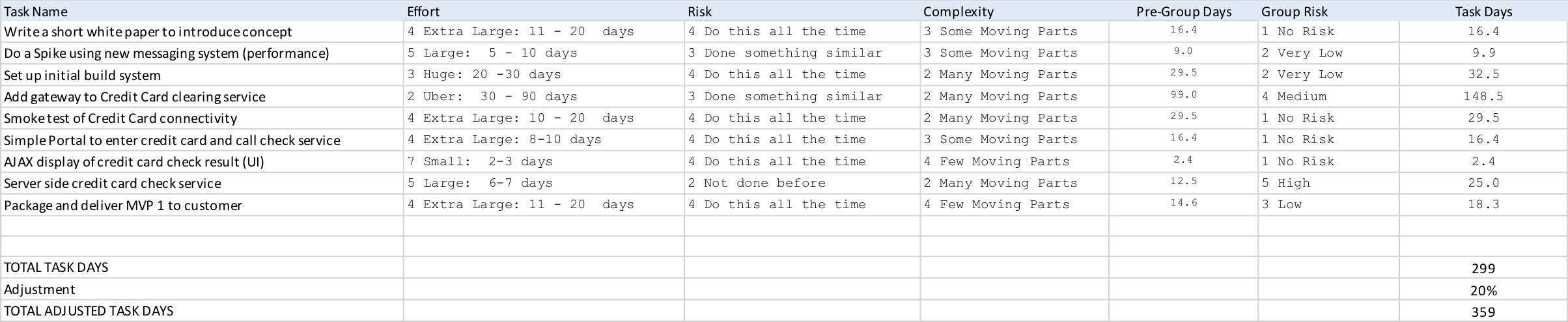
Below is a snapshot of the spreadsheet (columns will be explained in the following sections). This example
is included in the downloadable spreadsheet to help you get started. Each of the selection cells
is driven by a "Validation" worksheet.
That means as you select each cell, you will be presented with a dropdown. Note that you can tune percentages to
fit your environment.
Base Estimation Equation
Initially, the base estimation equation started by using a sliding scale based on the magnitude of the estimate
and
the effort range as a ratio to the maximum number of days. It had a number of weighting factors that came into
play.
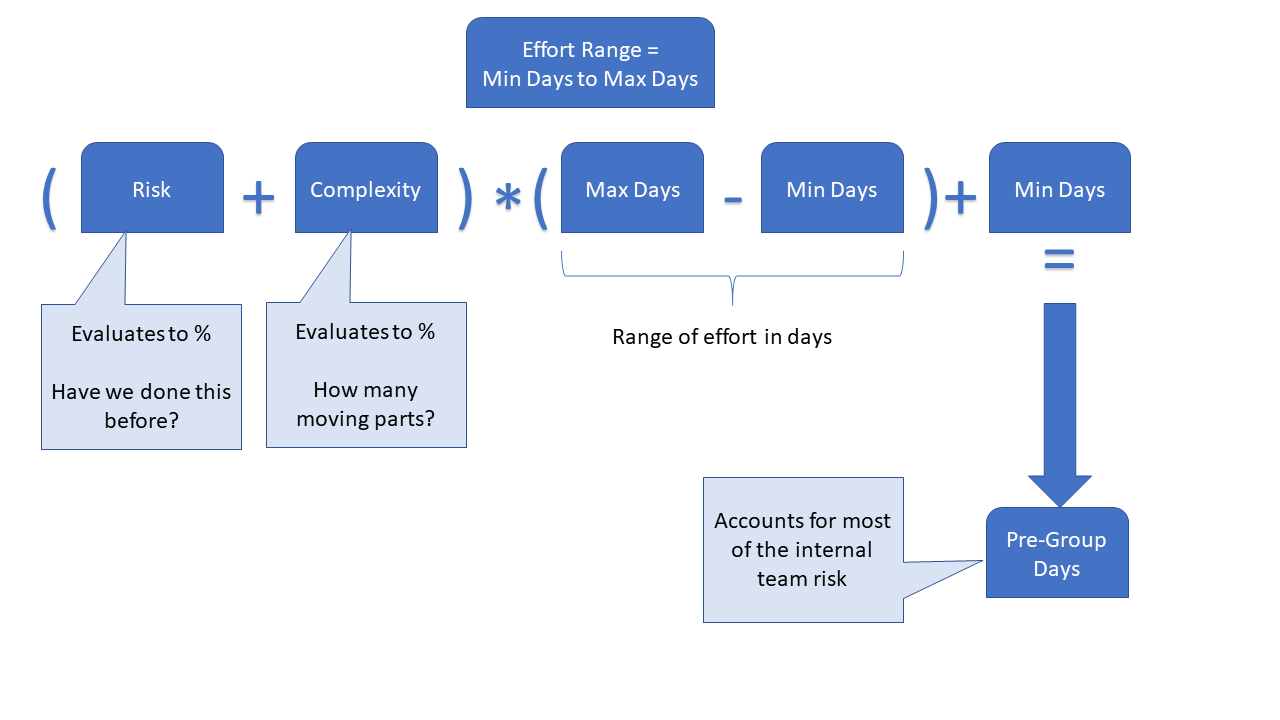
As we reworked the equation through real-life examples, we actually found the final equation
(presented below) much simpler and it provided the best results!
The base estimation equation is illustrated below:
Group Risk
The general form of the equation "settled" for a few years, though on occasion we would notice a large
miss on some of our projects. When we analyzed these misses, we realized that many of the impactful
factors where outside of the teams direct control.
Some examples of these outside factors include new 3rd party relationships which
often required legal help, or a new release process for the company.
These factors often caused rework, and other project inefficiencies.
We introduced a "Group Risk" item that would take an individual task line item and apply a separate
multiplier. As an aside, this multiplier can be as low as 1x (no impact), and as high as 3x!
Adjustment
I have found that on average, the spreadsheet is approximately 20% below the projected effort
once a more detailed plan is put together. There are definitely high-side outliers from this average,
though the more often you do this exercise, the better the results seem to be.
I have never seen a project come in under the early estimate.
Therefore, as a baseline, I always add at least 20% to the total estimated time. This number
should be adjusted further if the overall program has a high level of risk.
Recently, in a pre-seed startup scenario, there was considerable risk to the project. In this
case, I provided an investment range based on a low and high adjustment percentage.
Note that "Pre Group Days" in the following diagram comes from the previous diagram (the result of the
base estimation equation).
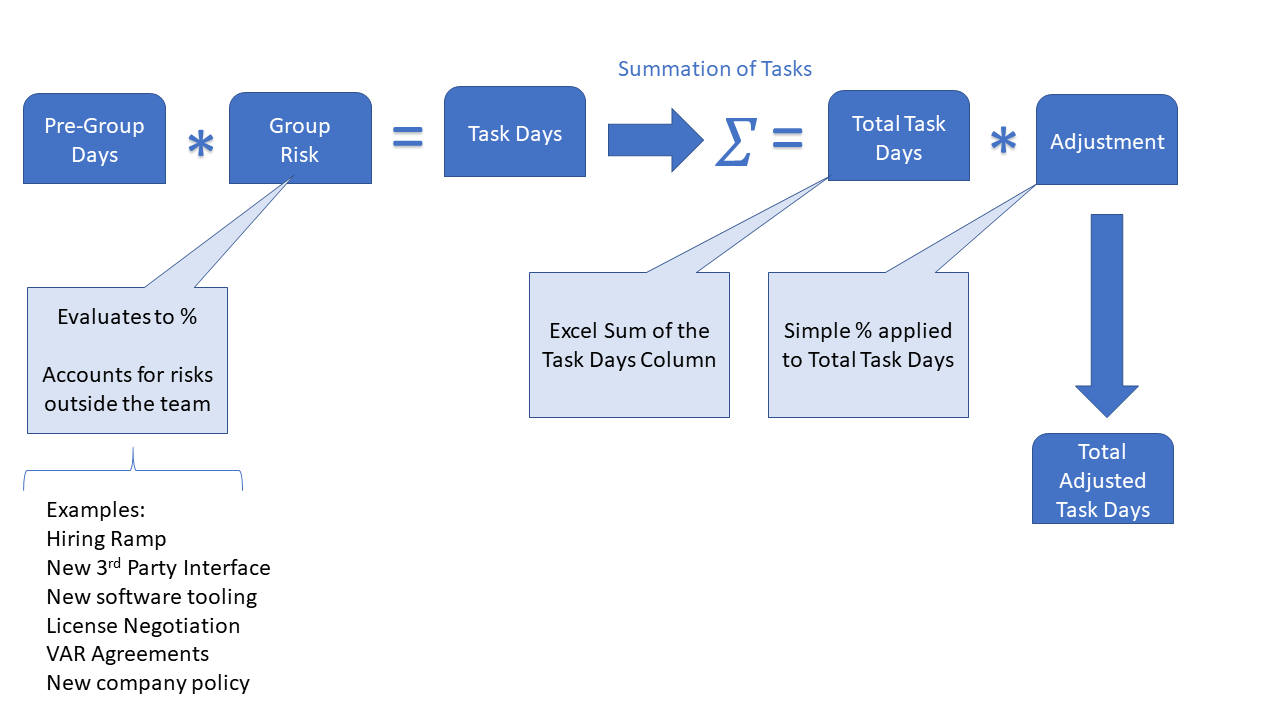
I usually hide the Pre Group Days column just to minimize the data noise.
A set of questions I ask the team when the total project estimate
comes out higher than expected:
- What items are introducing the significant risks into the estimates?
- What are the “BIG” questions or unknowns that we could quickly research?
There is a comment column used to record assumptions, as
well as outstanding questions. This can
be used as input to the next stage of your planning process if the project is
funded.
Costing
Note this spreadsheet does not try to differentiate engineering
specialties (architecture, development, testing, quality assurance, dev-ops, …). To suggest that the level of
detail
in this
spreadsheet is precise enough to account for engineering specialties,
would exaggerate its accuracy (as shipped). The goal
is to answer the breadbox, SUV or semi question. At times, the spreadsheet has been enhanced to represent specific
engineering roles, though it does take more time to come up with the estimate.
The estimation spreadsheet focuses on effort, not cost. Based on the project, we usually came up
with
a blended rate that was a fair representation of the team profile that would likely be involved in the project.
Product Management
Building this spreadsheet with Product Management participation
is an incredibly rewarding exercise. It helps the team focus on many important product questions very early
in the process, and it helps improve accuracy of the early estimates.
Product Managers will rightfully ask, “Why does
this cost so much?” It is an early
opportunity for engineering to respond with the various risks the teams may encounter. In my experience,
Product Managers can be extremely creative when looking for ways to
reduce risk—though the teams should respect the various specialties
in the room.
I have found the following scenarios when engaging with
Product Management while building this spreadsheet:
-
Product Managers can champion with other stake holders to gain support for the project during this exercise
-
The team comes away with a better understanding
of scope based on a healthy cost versus benefit discussion
-
Priority – which order do we think we need
things for MVP
-
Some items which are costly may be dropped from
the project all together – or fulfilled via a partnership or third party.
- Most importantly: The process offers a chance to build trust and respect between Product Management and
Engineering
For Product Managers – I know at first this may seem like a “dry”
exercise. If at all possible, I would
suggest you participate! Depending on
how close you are to the technology of your product – this exercise can provide
invaluable insights. I’ve also seen
these discussions lead to new capability ideas (“The real problem the customer
is trying to solve is this – and you're saying this widget is easy to build?”).
I’ve also seen new product lines evolve from
these discussions. And, as stated above, it promotes trust within the teams.
Summary
These are the benefits from the early estimation exercise:
-
You can provide an educated guess to cost,
though you should set realistic expectations on the risks associated with the early
estimate
-
You can have a reasonable coverage of high-risk
items identified depending on the level of detail you’ve put into the early
estimate
-
The early estimate is a reasonable input when you start building
a detailed funding proposal and/or plan, if you get a green light to proceed.
If Product Management was involved, everyone
walks away with a better understanding of the project. The team has also started building a skill set
that can be leveraged the next time someone proposes a new product idea.
In closing, there are a number of variables in building
these estimates, many of which are specific to your ecosystem. If you decide to use this spreadsheet, please
look at it as a starting point to be tuned to your particular environment!
Download Spreadsheet Here!
Questions and Answers
In this section, we will discuss follow on questions or comments that I have received, typically after
publishing an article.
|
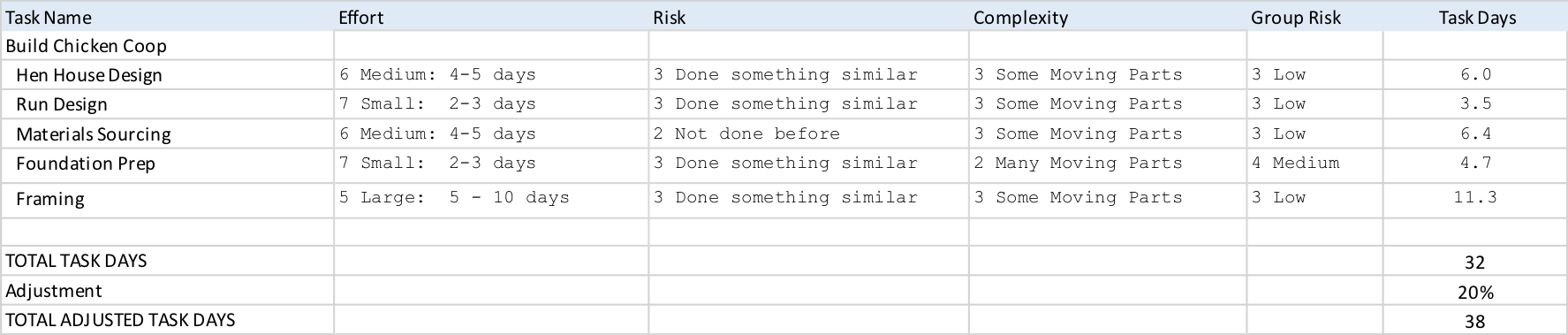
If you're curious, below is a fun example of the spreadsheet that a colleague of mine created.
Fun Spreadsheet Example
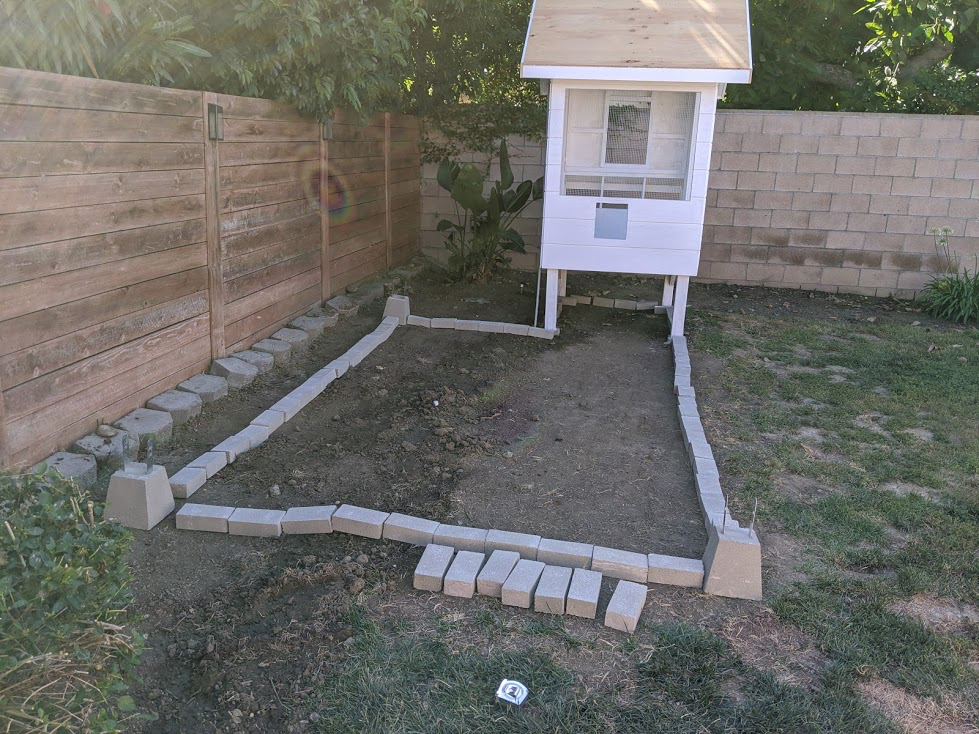
Below you will see an example of an estimation spreadsheet to build a chicken coop!

|
|
How does this spreadsheet and process relate to a methodology like COCOMO?
COCOMO Response
COCOMO is an estimation model that has evolved over time
with the input of a number of companies. It considers a many factors in creating an
estimate.
One example of these factors: "Personnel attributes" (capabilities of team members).
Carrying the above example a bit further, the model presented in this article presumes you
are in the early feasibility stages
of a project. You may not know which team members will participate, and you're usually very
short on time.
As an aside, time-boxing a feasibility estimate can be a good thing. It helps
to ensure you spend as little resource as possible on projects that turn out not to be feasible.
COCOMO
|